



Today marks the 57th anniversary of the first human footprints on the moon. At 10:56 p.m. Eastern time, Neil Armstrong stepped off the footpad of the Apollo 11 lunar module Eagle and took that "one small step for [a] man, one giant leap for mankind" as some 600 million people watched live on television here on Earth.
I vividly remember dashing back and forth between my backyard telescope and the living room, alternating views of the moon with glimpses of Armstrong and Edwin "Buzz" Aldrin's ghostly figures moving across its surface.
By a curious coincidence, if you have a small telescope, point it at the moon tonight. It is almost exactly the same phase it was on this night in 1969.
While no Earth-based telescope can reveal the relics of the landing, you can still locate the region where Eagle touched down. All you need is a little lunar geography.
In the photo below, which I captured with a 4-inch telescope on May 6, 2022, I've marked a few waypoints to help you find Tranquility Base.
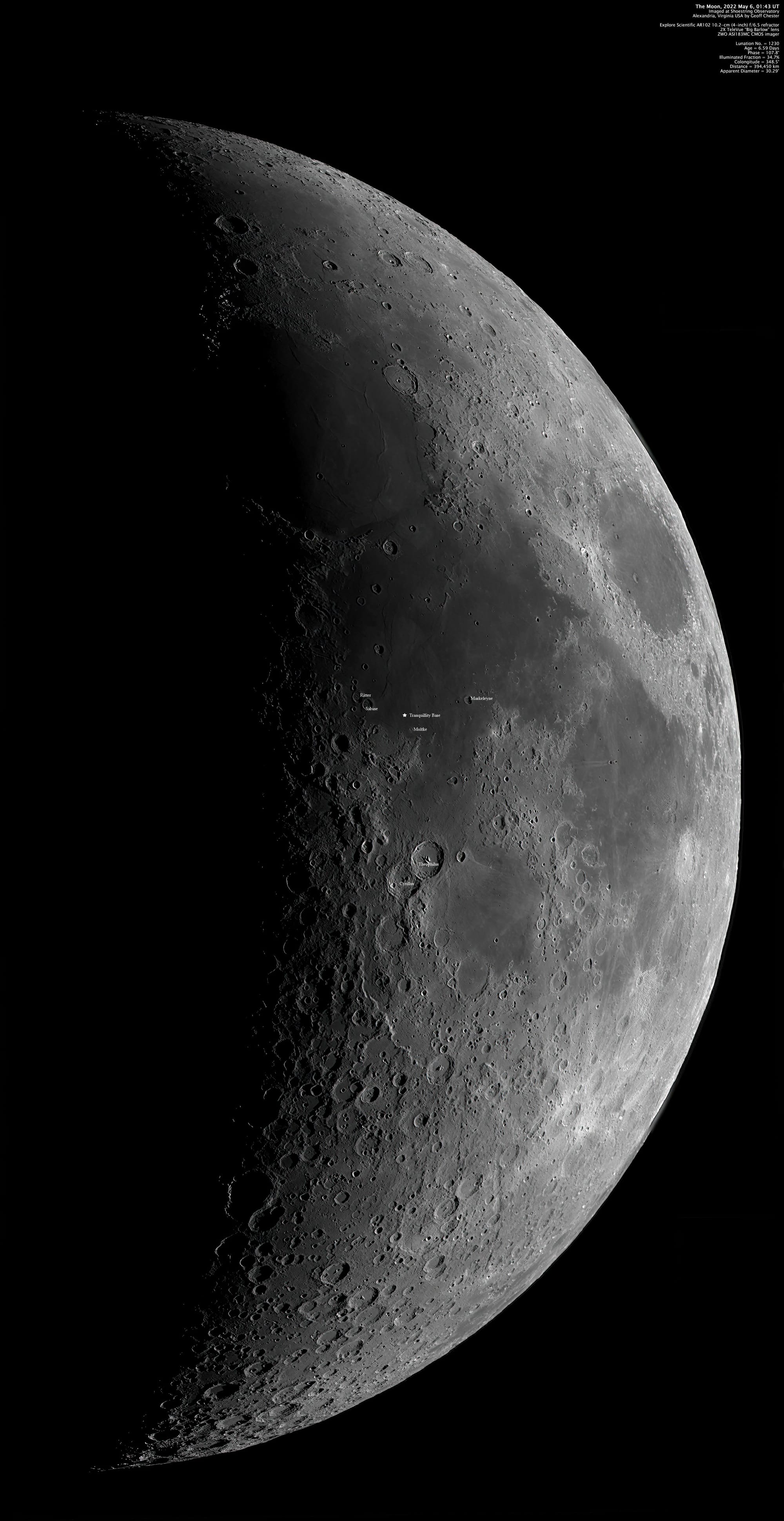
First, find the prominent craters Theophilus and Cyrillus near the center of the line dividing the moon's bright and dark portions. Then look just above them for the smaller craters Ritter and Sabine.
Now look for the tiny crater Moltke, nestled in a "bay" of flat terrain. The Apollo 11 landing site lies at about the 11 o'clock position relative to Moltke, just below an imaginary line connecting Sabine and the similarly sized crater Maskelyne.
To give you a sense of scale, tiny Moltke is about four miles across. Yes, the moon is pretty far away—and I still marvel that we've been there.


