



by Geoff Chester
If you happened to be outside around 7 a.m. Saturday, you probably had no idea that a sizeable asteroid — perhaps 0.6 miles (1 kilometer) across — was hurtling past Earth at a distance of 1,594,395 miles (2,565,930 kilometers), or about 6.7 times the distance to the moon. Asteroid 152637 (1997 NC1) belongs to a class of near-Earth asteroids known as Atens, which periodically cross Earth's orbit.
Most Atens measure only a few dozen to a few hundred meters across, making this one unusually large for its class. It is also classified as a Potentially Hazardous Asteroid, meaning its orbit could bring it close to Earth at some point in the distant future. If an object this large were ever to strike land, it could excavate a crater about 6 miles (10 kilometers) wide and loft enough debris into the atmosphere to affect the global climate.
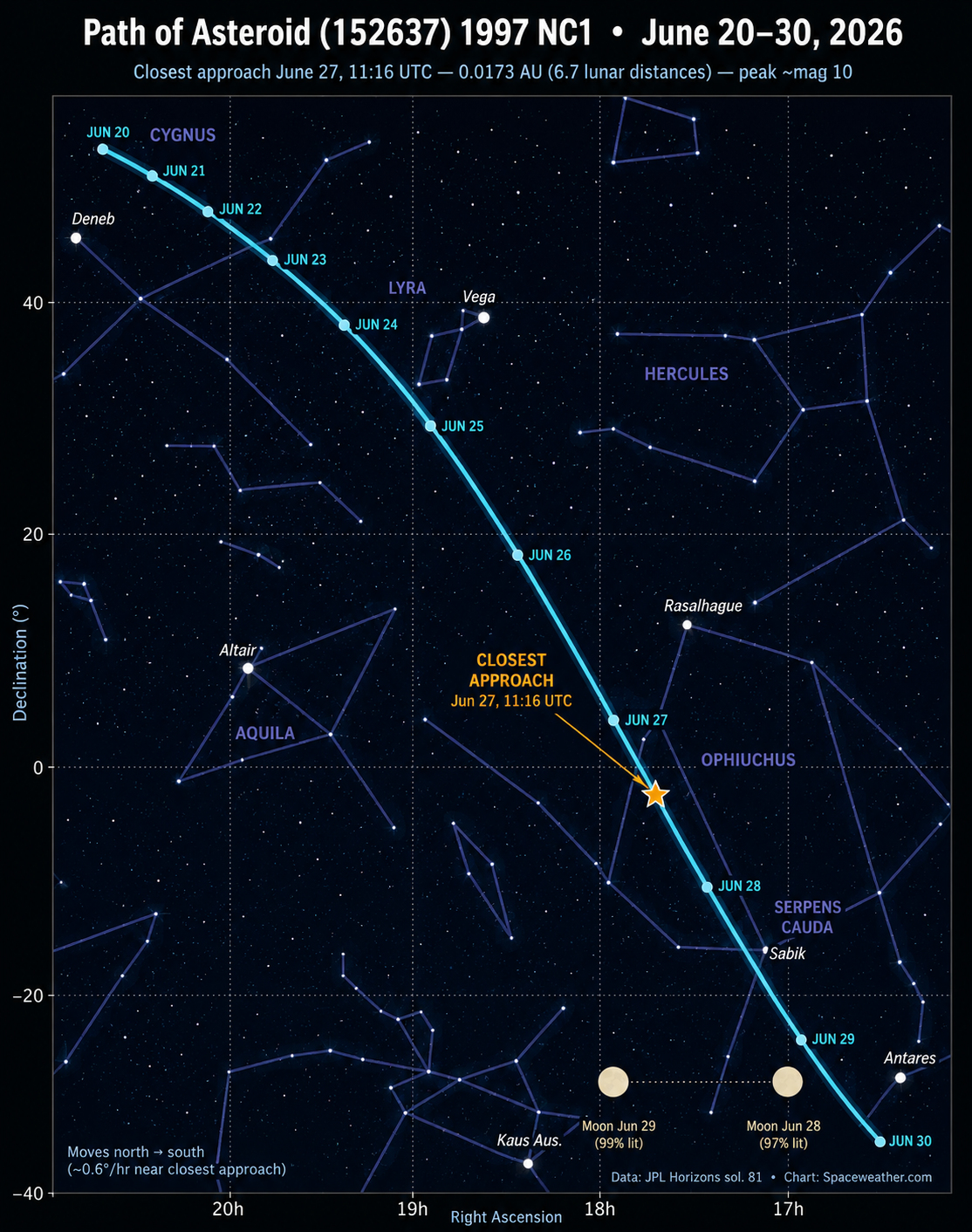
Fortunately, this asteroid poses no impact threat for at least the next 100 years. Its close flyby instead offers professional and amateur astronomers an opportunity to track its movement against the background stars and further refine calculations of its orbit.
Through the evening of June 29, the asteroid should be visible through modest amateur telescopes as a slowly moving point of light drifting through the constellations Ophiuchus and Scorpius. It will remain visible to observers in the Southern Hemisphere into the first week of July.
Here's a video I made of the close pass of asteroid (7482) 1994 PC1 on Jan. 22, 2022 over a 10 minute interval: Asteroid video
Each streak shows its movement over 30 seconds. It was captured with a 4-inch telescope from my front yard.
Geoff Chester is an astronomer who worked at the U.S. Naval Observatory for more than two decades.


