



When we describe how humid it feels outside, you'll almost always see us talk about dew point instead of relative humidity.
Relative humidity gets a lot of the attention. But when it comes to describing how muggy the air actually feels, it's often misleading.
Dew point tells the story much better.
Think of dew point as a direct measure of how much moisture is in the air. More specifically, it's the temperature to which the air would have to cool before becoming saturated and producing dew.
This may sound technical, but the takeaway is simple: the higher the dew point, the muggier it feels.
Relative humidity, on the other hand, doesn't tell you how much water vapor is actually in the air. Instead, it tells you how close the air is to being saturated at its current temperature.
Cool, saturated air often contains less moisture than hot air that's not even close to saturated.
Consider two afternoons:
- Day A: 72 degrees with 80 percent relative humidity
- Day B: 92 degrees with 45 percent relative humidity
Most people would assume Day A is more humid because the relative humidity is nearly twice as high. In reality, there's more moisture in the air on Day B.
[How humid does it get in DC? A look at dew points through the year]
The key is that relative humidity measures how close the air is to saturation — not how much moisture is actually in the air. Since temperature plays such a big role, relative humidity can change dramatically even when the amount of moisture stays exactly the same.
Consider a crisp autumn morning with a relative humidity near 100 percent. Overnight cooling pushes the air close to saturation, driving up the relative humidity even though there's not much moisture in the air. It may be damp enough for dew or fog to form, but it certainly doesn't feel muggy.
Dew point cuts through that confusion because it measures the moisture itself.
It gives us a much better sense of whether you're stepping into comfortably dry air or the kind of soup that leaves your shirt sticking to your back after a five-minute walk.
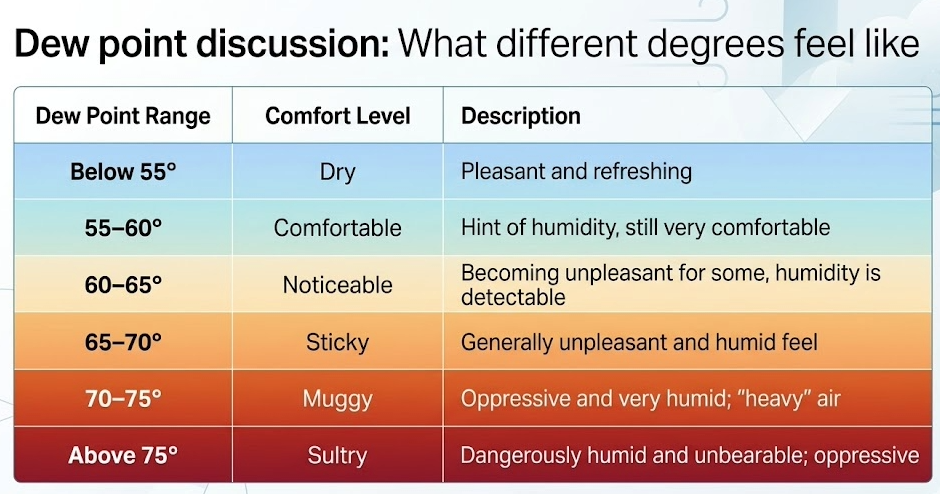
Around the DC area, summer dew points routinely climb into the upper 60s and low 70s. During the most oppressive heat waves, they can rise into the mid-70s and occasionally approach 80. At those levels, the air feels heavy, perspiration evaporates less efficiently, and simply being outdoors becomes exhausting.
It's also why visitors from the West are often surprised by summers here. Places like Phoenix and Las Vegas may experience much higher air temperatures, but their dew points are frequently 30 or even 40 degrees lower. The heat can be extreme, but it's a different kind of heat because the air contains much less moisture.
Relative humidity still has its uses. It's important in forecasting fog, clouds, and whether the air is nearing saturation. But if your question is simply, "How humid is it going to feel?" there's a better number.
So when we're talking about how humid it's going to feel, you'll hear us focus on dew point far more often than relative humidity. We think it's the most accurate —and most useful — way to describe what you'll actually experience when you step outside.


