



A thick plume of wildfire smoke is poised to surge into the DC area late tonight into Friday, bringing the worst air quality in years. The Metropolitan Washington Council of Governments has issued a code red alert for the entire metropolitan Washington region Friday because of the anticipated unhealthy levels of smoke pollution.
In addition, the Maryland Department of the Environment is forecasting code purple air quality in the western part of the state, where "very unhealthy" amounts of pollution are possible.
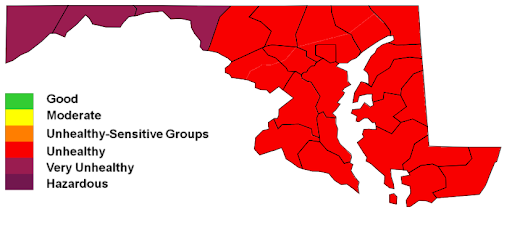
The smoke, originating from wildfires in northern Minnesota and western Ontario, has already fouled the air and turned skies eerie shades of orange across parts of the Great Lakes and Northeast. As winds carry the plume farther south, it's now the Mid-Atlantic's turn.
Light amounts of smoke began filtering into the region Tuesday but suspended high enough not to affect air quality. Thicker smoke was beginning to ooze southeastward Thursday, reaching northern Maryland, where air quality reached code red during the afternoon and evening.
Much of the region is under a code orange air quality alert Thursday, meaning unhealthy air for sensitive groups, both because of the approaching smoke and elevated levels of ground-level ozone.
Conditions are expected to deteriorate significantly by Friday.
"A weak cold front will move south Thursday night and Friday morning, ushering in a significant amount of smoke into Maryland that will persist all day Friday due to weak, recirculating winds," the Maryland Department of Environment writes.
The Metropolitan Washington Council of Governments (COG) has forecast a Code Red air day in the metropolitan Washington region tomorrow, July 17, due to smoke from Canada wildfires. https://t.co/CzH6MMoVnY pic.twitter.com/NxN8nXCAE5
— COG (@MWCOG) July 16, 2026
Some smoke may linger into Saturday, but afternoon showers and thunderstorms along an approaching cold front should gradually disperse and wash out the pollution.
The fine particles in wildfire smoke can travel deep into the lungs and even enter the bloodstream. According to the EPA, exposure can trigger asthma attacks and increase the risk of heart attacks, strokes and premature death. Young children, older adults, and people with heart or lung disease are especially vulnerable.
If you're in one of those higher-risk groups, limit time outdoors Friday or consider wearing an N95 mask if you must be outside. Indoors, keep windows closed and run your air conditioning with a MERV-13 or higher-rated filter, if possible.
You can monitor air quality levels on our health page.
Here are some of the additional impacts we might expect from the smoke:
- Smoky odor: The air may smell like a campfire.
- Reduced visibility: Hazy skies could limit how far you can see.
- Slightly cooler temperatures: Thick smoke can block some sunlight, trimming afternoon highs by a couple of degrees.
- More vivid sunrises and sunsets: Smoke particles scatter sunlight, often producing especially vibrant oranges and reds.
#SmokeSun rising on Thursday with the Old Post Office Tower in DC! @capitalweather @StormHour pic.twitter.com/4eEXNFuzwL
— Jeanne Stuart McVey (@RiverGirl707) July 16, 2026
The plume headed toward the region has already produced dangerous levels of pollution farther north. Late Wednesday into Thursday, air quality reached code maroon — the worst category on the Air Quality Index — in parts of Detroit and Minneapolis, which at times ranked among the most polluted cities in the world.
Detroit, Minneapolis and Toronto were the most polluted major cities in the world early Thursday.
— Ben Noll (@BenNollWeather) July 16, 2026
The air quality has reached hazardous levels near the Great Lakes. In some cases, conditions are worse than the apocalyptic June 2023 fires. pic.twitter.com/MAI3jtxqVv
If forecasts verify, this will be the region's worst air quality esince June 2023, when Canadian wildfires produced the most smoke pollution on record in the area.


