



To mark the nation's 250th anniversary, meteorologist and weather historian Sean Potter set out to answer a simple question: How has the weather on Independence Day changed since America was founded?
The answer is striking.
After reconstructing temperatures for 250 Fourth of Julys dating back to 1776, Potter found a clear warming trend. During the nation's first 50 years (1776-1825), only 4 percent of July 4s reached 90 degrees or higher. Since 1976, that share has climbed to 45 percent.
This year's Independence Day drove the point home. DC reached 103 degrees, setting a new record for July 4 and becoming the hottest Independence Day in the 250-year record.
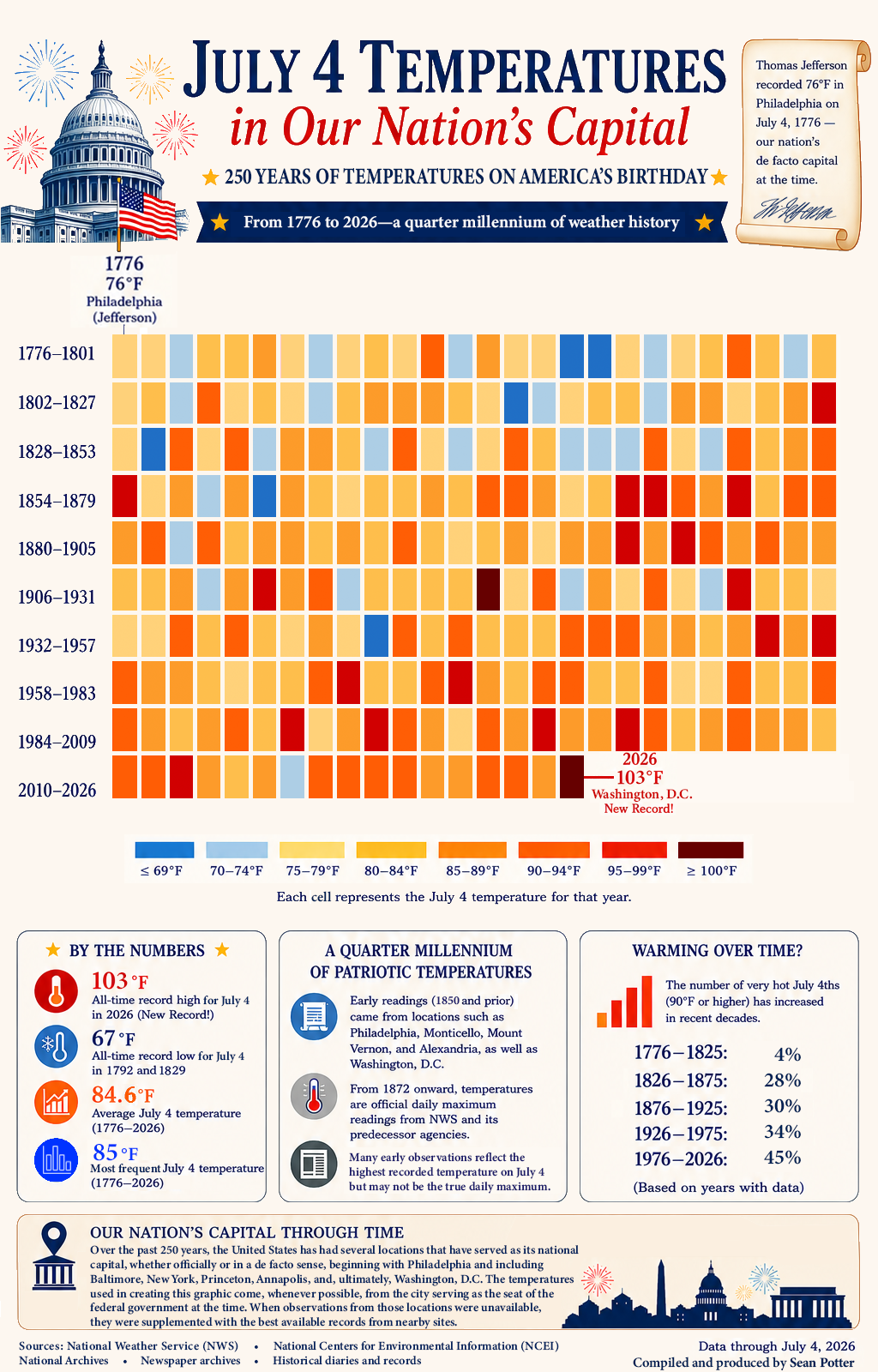
Piecing together 250 years of weather
Reconstructing a quarter millennium of July 4 temperatures wasn't as simple as looking up DC records. The District didn't become the nation's capital until 1800, and official weather observations in Washington didn't begin until 1872.
Instead, Potter used temperature observations from whichever city served as the nation's capital at the time whenever possible, supplementing them with the best available records from nearby locations.
Some of the earliest observations came from Thomas Jefferson, whose meticulous weather journals included measurements from Philadelphia, Monticello and Washington. Potter also drew on observations from George Washington at Mount Vernon, James Madison at Montpelier, David Rittenhouse and Lewis Brants in Philadelphia, and Isaac Beers and Ezra Stiles, president of Yale University, in New Haven.
One of the more remarkable entries comes from Stiles' diary. He recorded the temperature on July 4, 1779, but the following day British troops captured New Haven during the Revolutionary War. In the hurried evacuation, Stiles wrote that he accidentally broke the thermometer Benjamin Franklin had obtained for him in London, ending his weather record until the following year.
Because the reconstruction draws from multiple locations—some north of Washington where July temperatures are naturally cooler—the long-term warming trend may be somewhat overstated. In addition, many early observations represent the highest temperature measured during the day rather than the true daily maximum.
Even with those caveats, the DC record since 1872—based entirely on official observations for the District—shows an unmistakable warming trend.
Highlights from the 250-year record
- Hottest July 4: 103 degrees (2026)
- Coolest July 4: 67 degrees (1792 and 1829)
- Average July 4 high: 84.6 degrees
- Most common July 4 high: 85 degrees


