



When the Declaration of Independence was signed 250 years ago, the weather bore little resemblance to the scorching, steamy conditions we're enduring today. Instead, it was remarkably pleasant.
Thomas Jefferson — an avid weather observer who kept a weather diary for more than 50 years — recorded four temperature measurements in Philadelphia on July 4, 1776. They indicate a comfortably mild day, with temperatures in the upper 60s and 70s, or roughly 25 degrees cooler than those forecast for July 4, 2026.
Here are Jefferson's four observations:
- 6 a.m.: 68 degrees
- 9 a.m.: 72.25 degrees
- 1 p.m.: 76 degrees
- 9 p.m.: 73.5 degrees
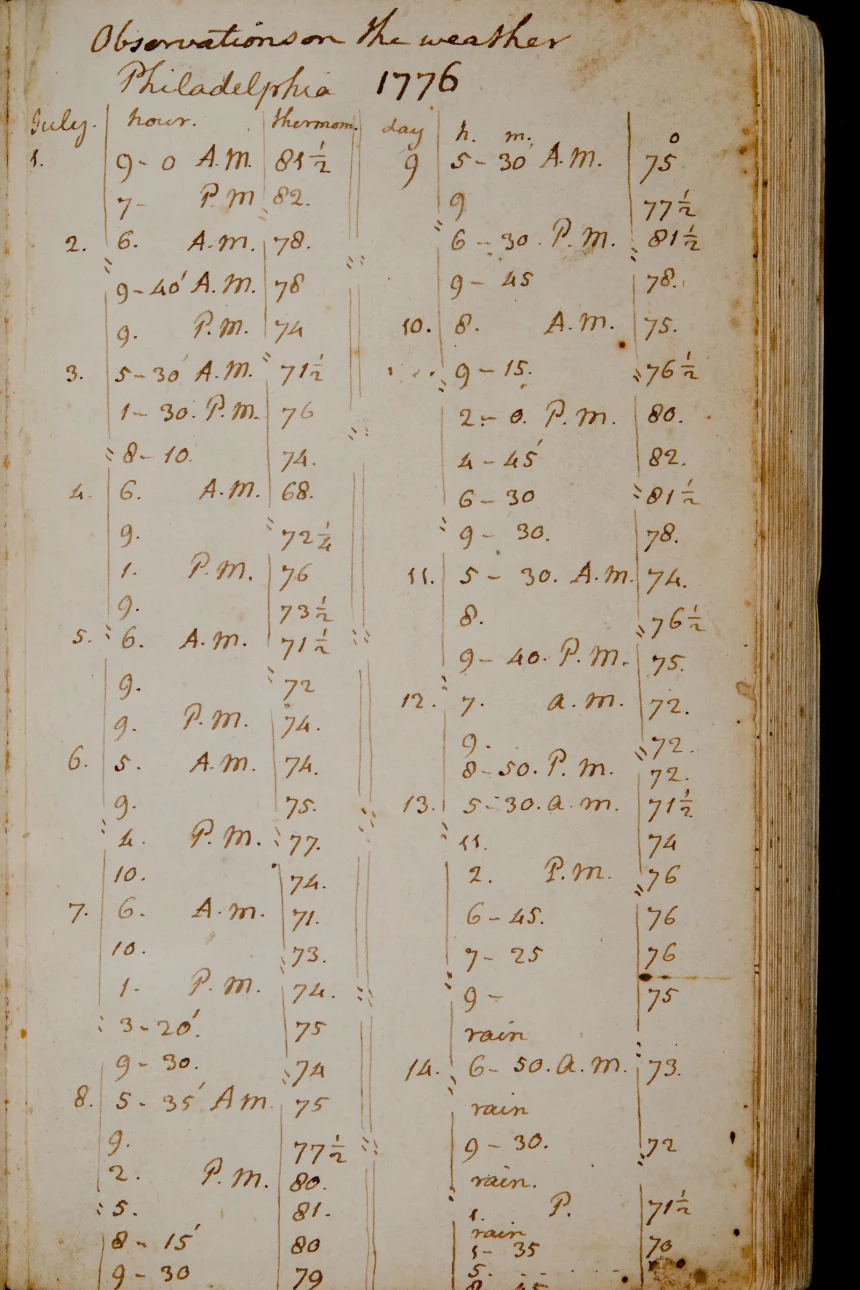
We're not aware of any weather observations from what is now the DC area, as the city wasn't established until 1790. But Philadelphia and DC have similar climates — Philadelphia averages about 2 degrees cooler in July — so it's reasonable to assume conditions here were also relatively mild.
Contrast that with the forecast for July 4, 2026: highs of 100 degrees in Philadelphia and 102 in DC
The stark difference between the weather in 1776 and 2026 is also a reminder of how much the climate has changed over the past 250 years.
When the Declaration of Independence was signed, it was before the Industrial Revolution and the large-scale burning of fossil fuels. Since then, atmospheric carbon dioxide concentrations have risen by more than 50 percent, and average temperatures have increased by several degrees.
According to an analysis released Friday by the World Weather Attribution project, the extreme heat and humidity affecting much of the eastern United States this week would have been "virtually impossible" without the influence of human-caused climate change.
“On America’s 250th birthday, our study gives a clear reality check,” lead author Theodore Keeping, a climate scientist at Imperial College London, said in a statement. “The climate the country has today is fundamentally different to the one it had when the Founding Fathers signed the Declaration of Independence.”


