



Friday brought one of the worst smoke-driven air quality events in the modern record around DC, with conditions ranging from unhealthy (code red) to very unhealthy (purple) for much of the day and briefly reaching hazardous (maroon) levels.
Around DC, it ranked among the worst air quality in the modern record. Its smoke pollution, at times, ranked third worst among world cities.
A thick, pungent plume of wildfire smoke swept into the region Thursday night behind a cold front and lingered into at least Saturday morning. It was reminiscent of the historic smoke outbreaks of June 2023, when many in the region first experienced air pollution of this magnitude.
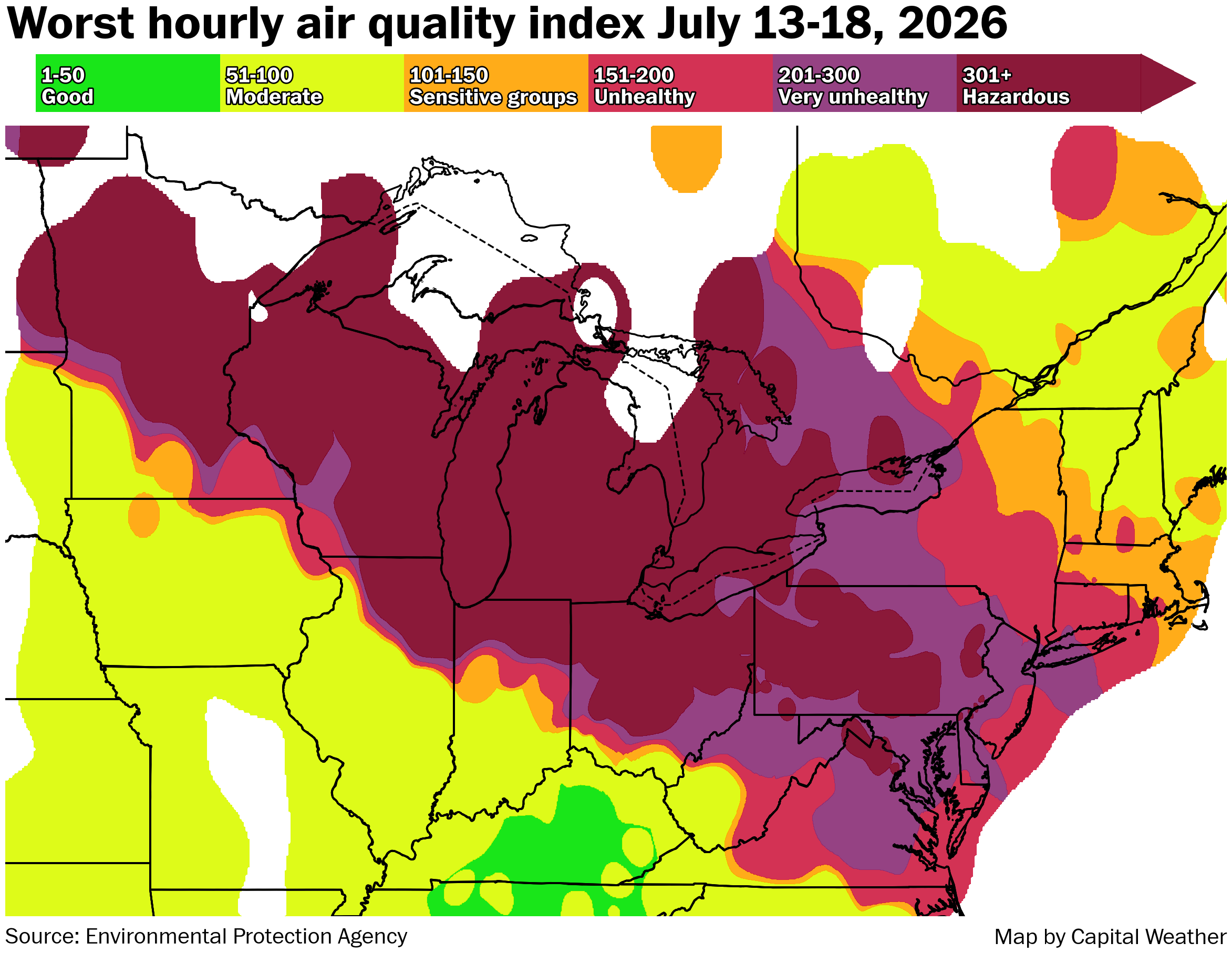
The major smoke events in June 2023 originated primarily in Quebec, with additional smoke from western Canada. This time, the source region was mainly western Ontario and northern Minnesota. In both cases, the smoke was fueled by human-caused climate change influencing massive, generational wildfires burning across the boreal forest.
Worth reading: Canada's boreal wildfires aren't just bad forest management
Pollution rankings near or above 2023
Based on daily average concentrations of tiny pollution particles known as PM2.5, this event was roughly on par with — and in many locations slightly worse than — the major smoke outbreaks of June 2023.
| Location | 2026 | June 8, 2023 | June 29, 2023 |
|---|---|---|---|
| Central DC | 108.6 | 119.4 | 80.0 |
| Eastern DC | 99.4 | 98.9 | 75.5 |
| Rockville, MD | 110.6 | 71.9 | 75.7 |
| Beltsville, MD | 121.1 | 114.2 | 84.9 |
| Franconia, VA | 143.5 | 146.8 | 93.1 |
| Baltimore, MD | 114.7 | 114.3 | 96.0 |
| Winchester, VA | 169.9 | 64.2 | 103.4 |
The chart above compares PM2.5 concentrations (measured in micrograms per cubic meter, or μg/m³) at air quality monitors around the DC region during the largest recent smoke events. We use PM2.5 concentrations rather than the more familiar Air Quality Index (AQI) because they provide a more direct measure of the amount of smoke pollution in the air.
Among the stations shown, Eastern DC, Rockville, Beltsville and Baltimore in Maryland, along with Winchester, Virginia, recorded higher daily PM2.5 concentrations than during either of the June 2023 smoke events. Central DC and Franconia, Virginia, fell just short of their June 8, 2023, peaks.
Air Quality Index this year versus 2023
The map below compares peak Air Quality Index (AQI) values this year compared with 2023. Because the EPA updated the AQI calculation in 2023, we focus on which event was worse rather than comparing the exact values.
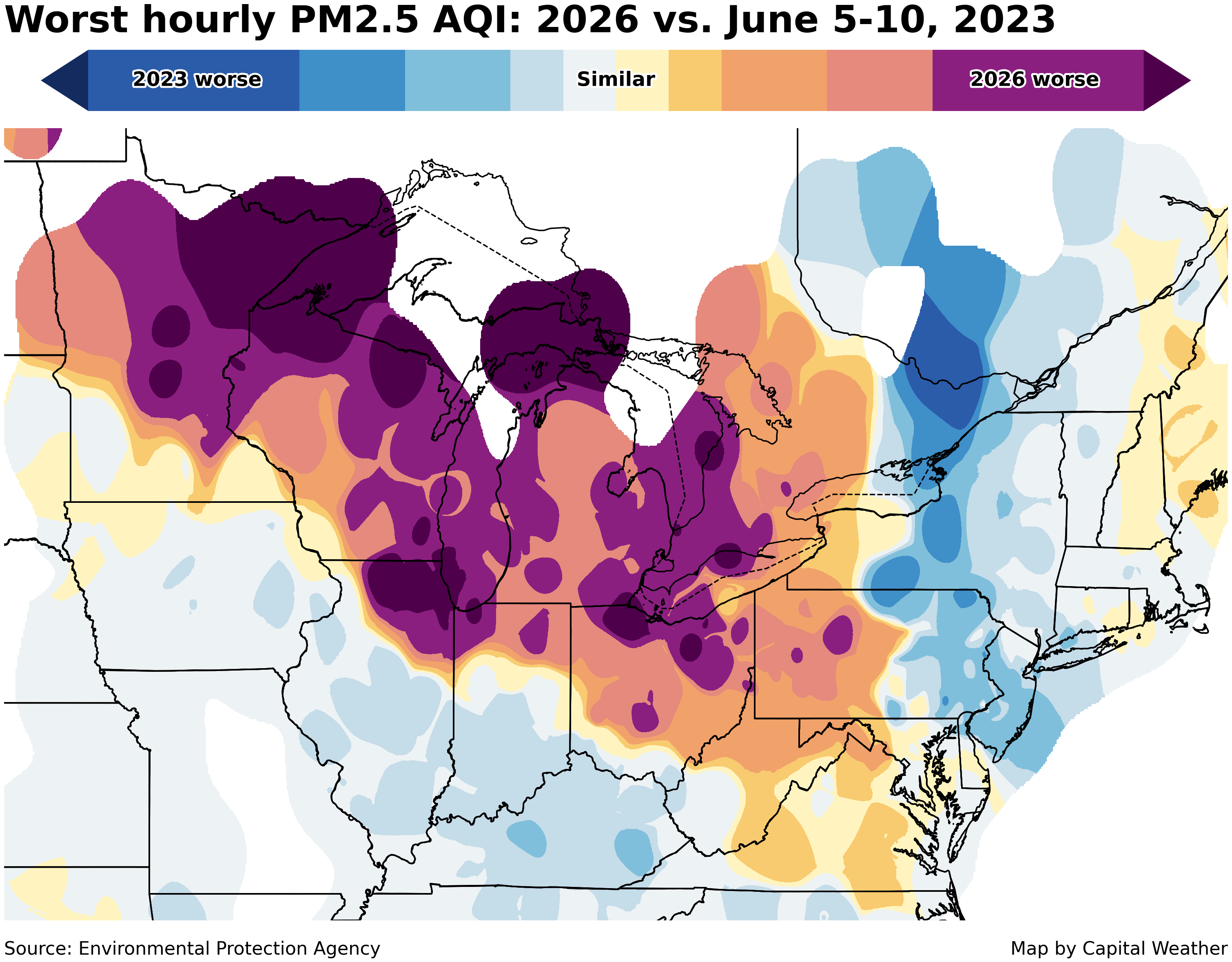
Across the Great Lakes and Upper Midwest, this event was generally worse — in some places much worse — than the June 2023 smoke episodes. Many locations reached hazardous air quality and remained there for an extended period.
Closer to home, the comparison is much tighter. As with the daily PM2.5 averages, the biggest June 2023 event generally had the edge in areas east and northeast of DC, while this week's event was comparable or slightly worse in many other locations. The second June 2023 smoke episode was less intense locally, though it lasted longer.
Surface smoke and low visibility
The smoke wasn't just evident in air quality readings. It was also plainly visible at ground level, reducing visibility and giving the sky a milky, smoky appearance.
Through 4 p.m. Saturday, Reagan National Airport had logged 42 consecutive hours of smoke in its official weather observations — the longest such streak on record there, surpassing the previous mark of 31 hours set in early November 1952.
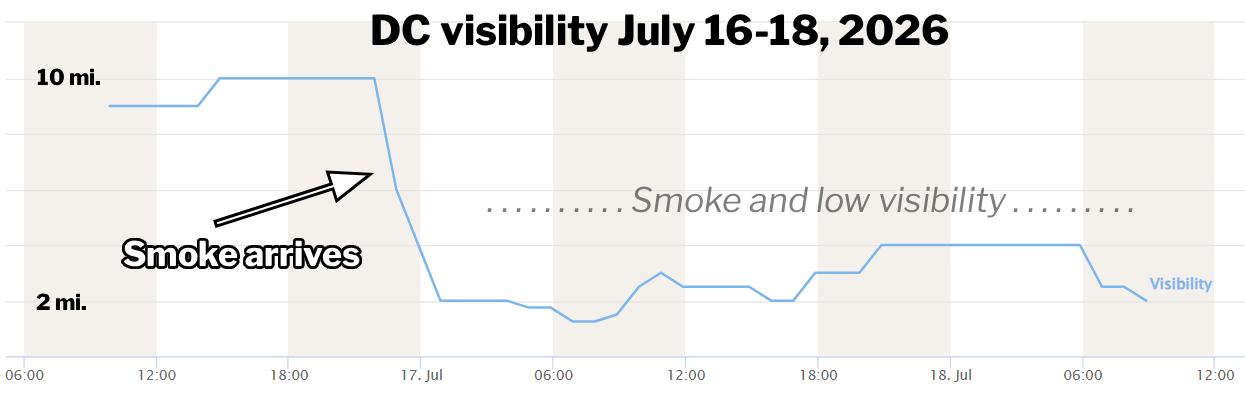
One caveat: weather observers don't always classify these events the same way. During the major smoke outbreaks of June 2023, the dominant observation was "haze" rather than "smoke." National recorded 44 consecutive hours of haze from June 28 to 30, 2023, and another 26-hour stretch from June 7 to 8.
Not just particle pollution (PM 2.5)
In addition to the smoke pollution, Friday also brought a code red alert for ground level ozone in DC and nearby areas just to the south of the thickest smoke. In these locations, enough sunshine filtered through the smoke to fuel ozone formation.
It was a really bad air day for DC. A pollution double whammy.
— Capital Weather (@capitalweather) July 18, 2026
Not only did smoke pollution reach code purple (very unhealthy) levels this AM and hover at code red this PM, but ground-level ozone, another pollutant, spiked to code red this afternoon.
This is not something we… pic.twitter.com/SD9sS8XdSu
It was DC's first code red ozone day since 2023. By contrast, Baltimore — buried beneath the thickest smoke — never rose above code yellow for ozone because so little sunlight reached the surface. PM10, a larger class of airborne particles than PM2.5, also briefly reached code red levels.
Friday's ozone spike was more associated with wildfire smoke than the usual local pollutants. Code red ozone alerts used to be relatively common but are now rare because of air pollution regulations.


