



Promoted as a potential world record for the most fireworks in one show, and certainly the largest ever seen in the nation's capital for the Fourth of July, 850,000-plus shells are expected to be launched from locations on the National Mall, the Potomac River, and West Potomac Park.
Sound familiar? In 2019, President Trump and the National Park Service promised the biggest show DC has ever held. Once underway, it was promptly smoked out.
"Instead of a dazzling Technicolor display, many disappointed spectators only saw what looked like fog illuminated by dull spotlights," Capital Weather's Jason Samenow wrote at the time.
That event was considerably smaller than this one is billed. So was one in 2016 that had humid weather with low clouds, some lingering rain, and views that were promptly destroyed. PBS infamously cut to footage from past years to keep the show going while getting skewered on social media for doing so.
While those are a few of the more notable examples, it's not that uncommon for nighttime weather conditions to trap fireworks smoke. In fact, typical summertime conditions in DC are rather favorable for bad viewing and bad air quality during the Independence Day celebration.
Changes this year
According to a May article in The Washington Post, the approximately 860,000 shells anticipated in this year's show will be at least roughly 50 times more than the usual 10,000 to 20,000 shells.
Besides sheer shell volume, there will be many more launch locations – eight on the Potomac River and one from West Potomac Park – than usual. In a standard year, all fireworks are launched from a location near the Lincoln Reflecting Pool, although the 2019 show also fired some from West Potomac Park.
Perhaps the most comparable event is the 35,000 shells that were fired from multiple locations in about five minutes to celebrate President Biden's inauguration in January 2021.
This year's fireworks show will also be late – officially scheduled for 10:30 p.m., but possibly not until 11 p.m. – instead of the usual first volley around dusk, which is typically about 9:10 p.m.
The late start is far from ideal for photographers given the most striking images tend to come while there's still a hint of blue in the sky around twilight, before smoke overtakes the scene. In the case of this year, it also means more waiting after a long day in extreme heat.
Standard Fourth of July conditions
On Independence Day, DC is typically nearing its hottest and most humid time of year, although there are cooler exceptions – the high temperature of 75 on July 4, 2016, was the second-coolest for the date.
July Fourth's average high of 89 is one tick below DC's highest average high, which is 90 degrees from July 6 to 27. The average low on the Fourth is 72. Humidity season is often cooking, as is thunderstorm season, both adding moisture to the atmosphere that can keep temperatures elevated during the show and increase the potential for poor visibility.
The most common wind directions for July in DC are all some version of out of the south. From due south to north is most common, from southwest to northeast is second, and southeast to northwest is third. Given that smoke is most commonly being blown northward or thereabouts, that means it is often tough viewing north of the National Mall in DC.
Wind speeds are commonly lower in summer, as well, partly because of the increased likelihood for stable high pressure to be in control. Winds are also generally at their lowest at night through early morning.
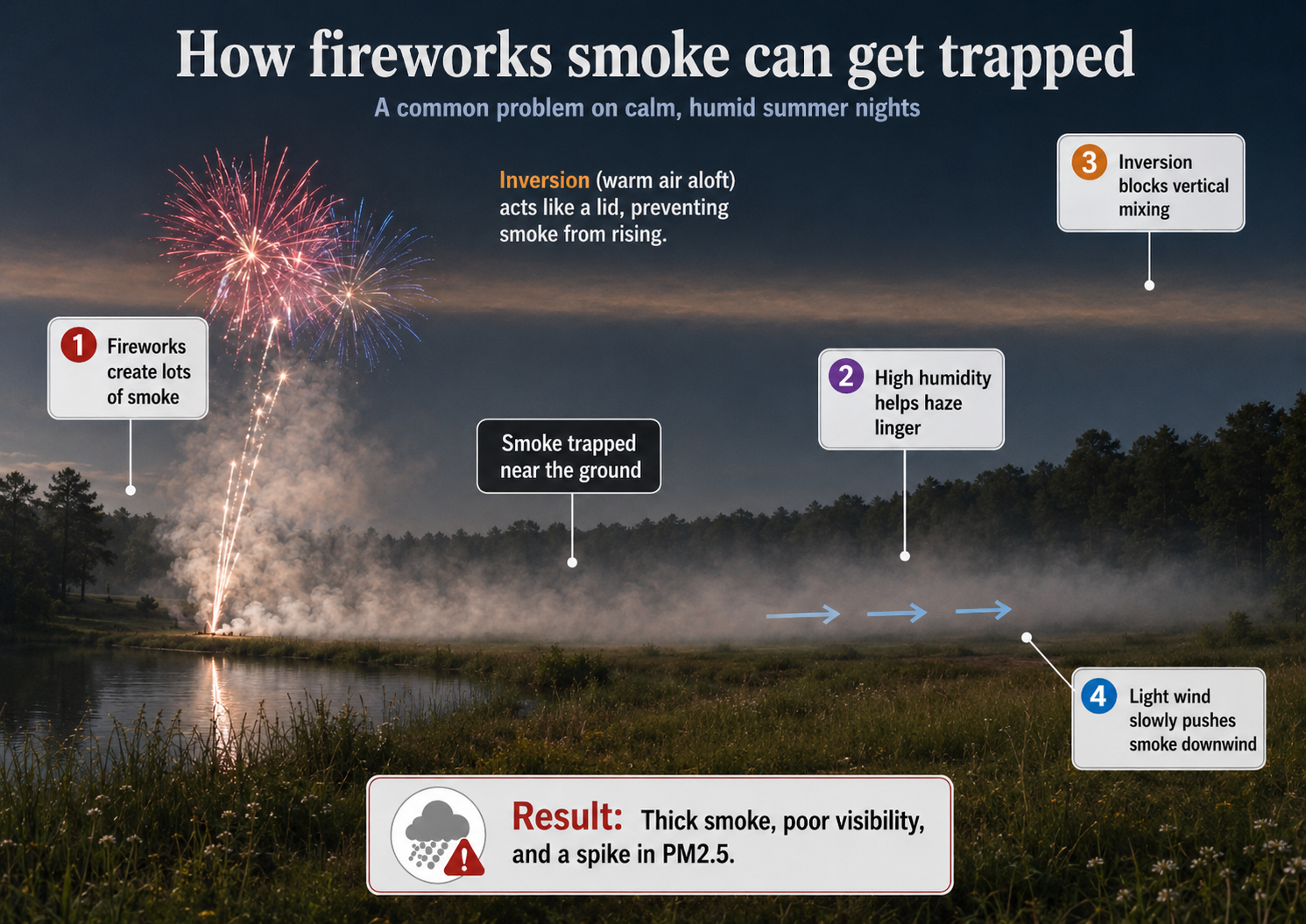
Finally, there's the dreaded temperature inversion: Warm air layered on top of cooler, keeping surface air from rising and thus trapping smoke (or sound) closer to the ground. A hot day leading to a still night only makes a temperature inversion more likely, as does the National Mall's elevation near sea level.
It was such a temperature inversion that contributed to the disappointing display in 2019.
How recent years played out
Bad air from smoke is the expectation, not just in DC but all across the country.
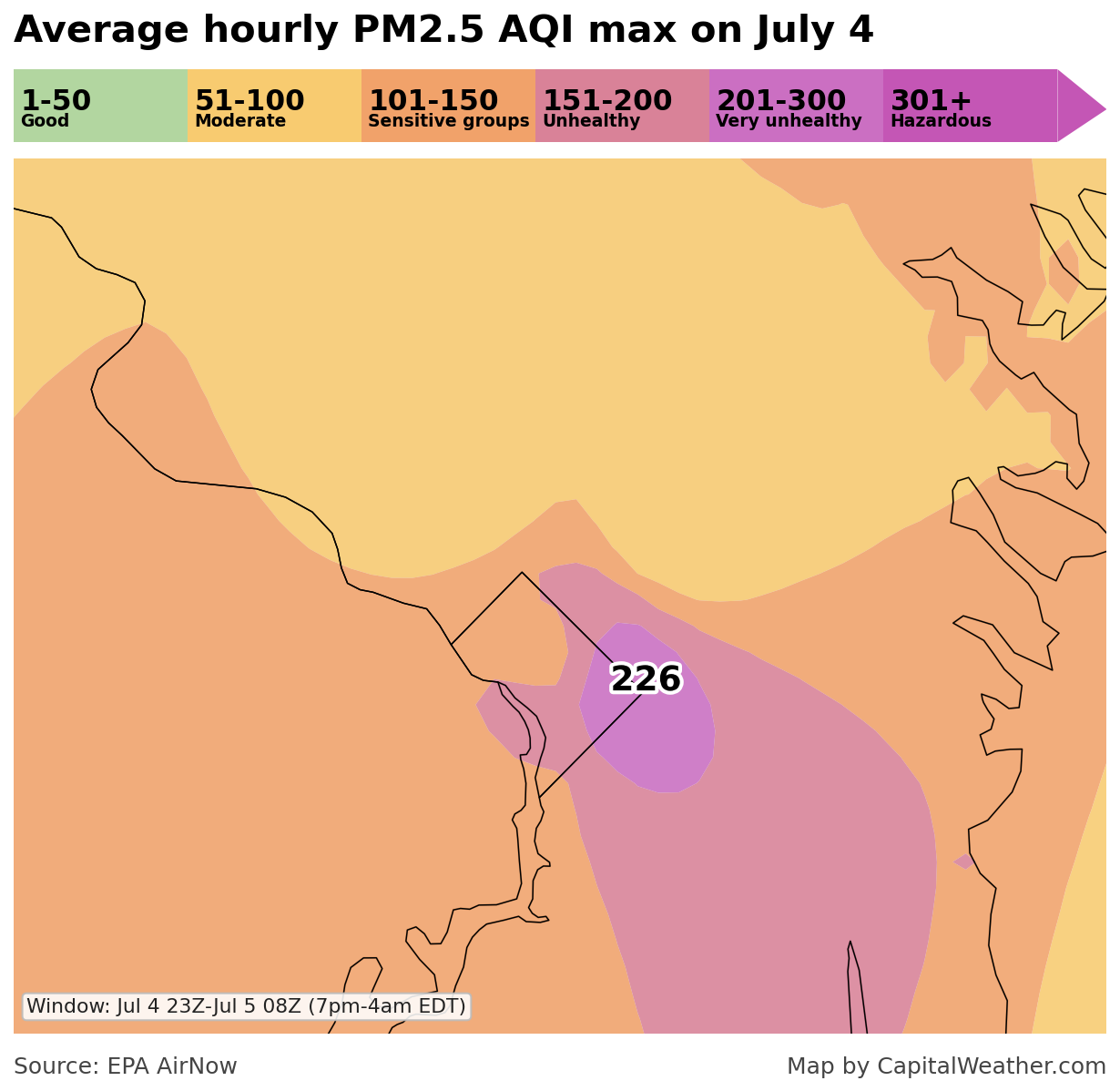
Last year I looked at it from a national lens, showing how all big cities – plus small towns, and individual driveways – see freedom explode in the form of vast increases in tiny PM2.5 particulates in the air the night of Independence Day.
Interestingly enough, air quality during and after the 2019 event was not the worst of recent years in and around DC, which brings up a crucial point.
Thick smoke from fireworks displays is not necessarily a perfect correlation to high PM2.5 concentrations. By nature, these particulates are invisible to the eye and levels can be high without any accompanying thick or visible smoke.
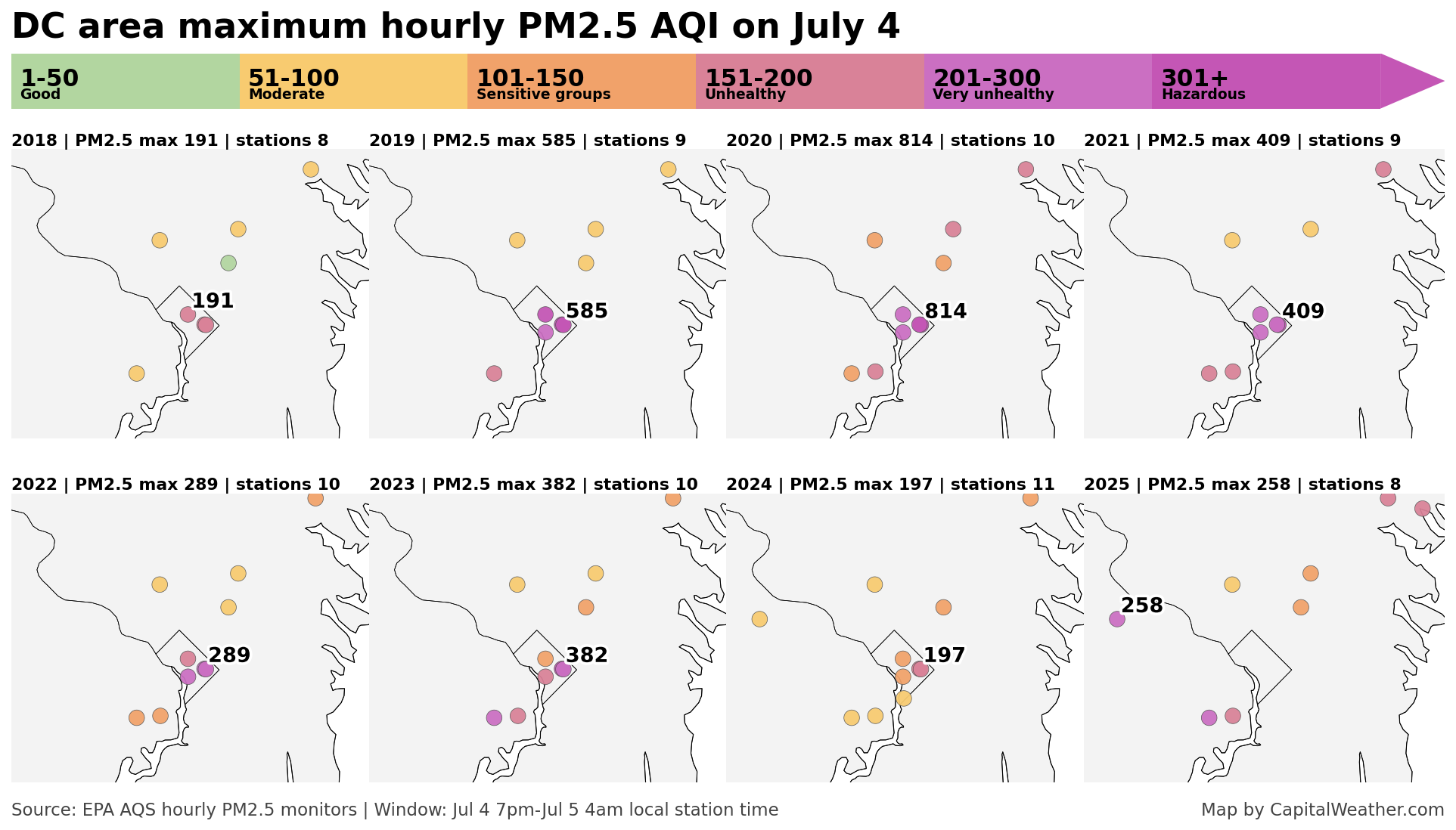
Over recent years with available data, the highest values in our area recorded annually are all in the District, and all ugly. Keep in mind an AQI of 301 is the beginning threshold of hazardous air.
- 2020 - 814 PM2.5 AQI
- 2019 - 585 PM2.5 AQI
- 2021 - 419 PM2.5 AQI
- 2023 - 382 PM2.5 AQI
From 2018 to 2025, the average hourly peak readings at DC stations were in the unhealthy to hazardous range. It's a relatively short peak compared to other pollutants, often lasting a few hours or less. But those spikes in bad air quality are focused on population centers – more people = more fireworks = more smoke.
What this year may offer
Get your views of the main DC show in early (relatively speaking).
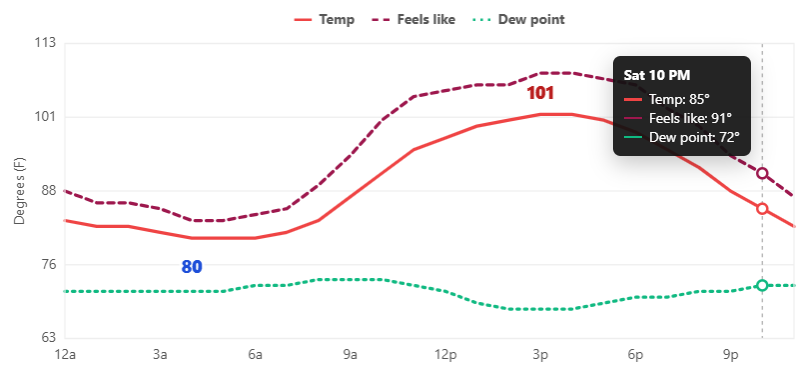
Unless there are strong winds, there will very likely be near-record amounts of smoke to go with all the fireworks. As of now, winds only look to be around 5 to 8 mph, which will struggle to push the smoke along. If a chance of scattered storms materializes, it could become even more humid and primed for smoke to hang around.
In some sense – oddly enough – the potentially historic heat wave leading into the Fourth may help out, at least a little. That's because the large area of high pressure responsible for the heat will probably be drifting west, which would favor a drier wind out of the west or northwest, rather than more from the south.
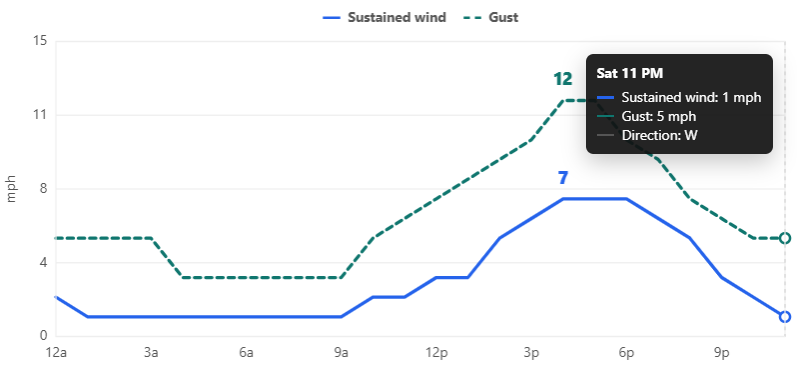
Another potential positive is that humidity could – emphasis on could – be slightly lower versus some years. Although the humidity probably rises as the night progresses, so the late start doesn't help.
With the ongoing drought, we'll also have heightened concern for fires. Light winds may cooperate to mitigate the expansion risk of any blazes, and large fire starts are not likely from the DC show itself.
One thing is for sure, it'll be the worst of DC summer as far as temperatures. With near-record highs around 100 anticipated, you'll want to take it easy wherever you camp out to wait and watch the sky shimmer in light.


